
When Memory Becomes Protest: David Wojnarowicz and the Archive
Avery Thomas
2 August 2026
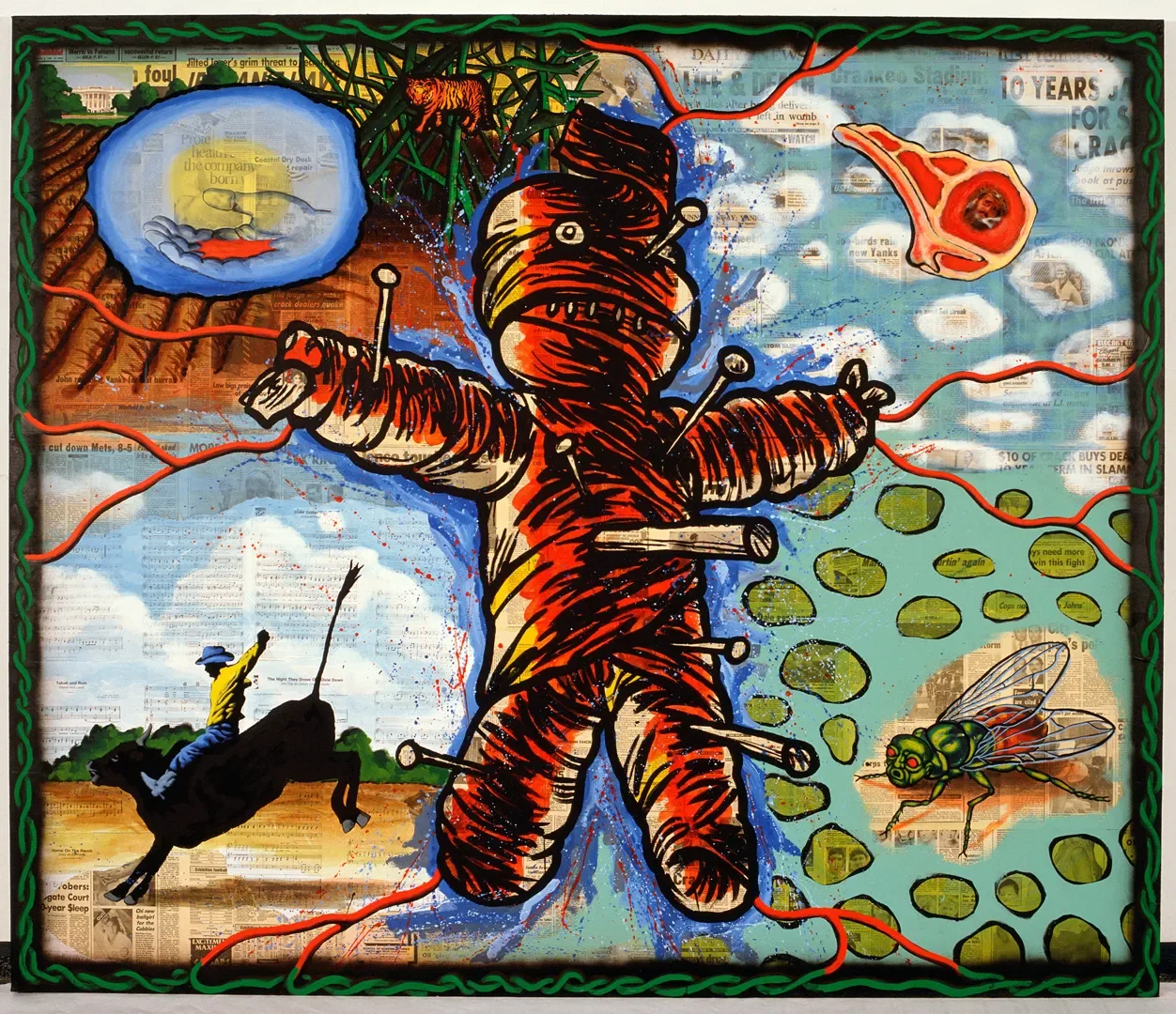
The Newspaper as National Voodoo: A Brief History of the U.S.A., 1986. Acrylic, spray paint, and collage on wood, 67 1/2 x 79 5/16 in. Courtesy of The David Wojnarowicz Foundation.
History is often presented as a collection of facts, but archives are formed through conscious choices: what gets preserved, what gets displayed, and what gets forgotten. David Wojnarowicz was someone who constantly questioned those choices.
Newspapers, as "official" historical records, function like archives in that they preserve accounts of current events and daily life, often capturing moments as they unfold before stories change, new perspectives emerge, and memories begin to fade. Like any archival source, they hold valuable and often reliable information. Journalism, founded on the purpose of informing the public, and art, rooted in personal expression, occupy two very different positions in shaping how society understands the world. Neither journalism nor art alone provides the definitive account of current events, but the institution built on informing the public inevitably commands greater public attention. As a result, journalism holds far greater influence in shaping collective memory.
The social environment of New York City, particularly during the AIDS epidemic of the 1980s, was profoundly shaped by the media. What Wojnarowicz chose to explore in his work consistently exposed manipulation within American narratives, revealing how art itself can become a form of memory—one that deserves to be remembered alongside the histories presented by the press.
INTRODUCTION
Remembering as a political act is an idea that has always remained central to David Wojnarowicz's work. His art demonstrates that the archive is not simply a collection of historical records, but a contested space where marginalized communities preserve experiences that dominant systems and institutions attempt to erase. Through paintings, photographs, and writings, Wojnarowicz transformed personal memory into political resistance, creating an alternative archive of queer existence, governmental and societal neglect, and the AIDS crisis.
SECTION I
The Archive of a Nation: Media, History, and Erasure
Wojnarowicz lived in a time and place where gay men and the broader queer community faced intense oppression, forced underground by those who believed themselves morally superior—those who viewed the epidemic as a plague sent by God to punish "sinners." During the AIDS epidemic, media coverage of the deaths of gay and bisexual men and drug users remained deliberately sparse, as many journalists believed these lives were not worth reporting on. Only when the public began to realize that AIDS was not solely a "gay disease" did coverage become more widespread. Government silence further reinforced the idea that queer deaths were somehow acceptable or insignificant; if the disease had been affecting anyone else, the nation would have spoken.
It was within this climate that Wojnarowicz became no stranger to media suppression and censorship. His work was misrepresented, ignored, or hidden because of its visceral nature. These reactions from the mainstream only fueled his uncompromising and unapologetic attitude. He had no reason to trust the media when he repeatedly witnessed the truths it attempted to conceal.
The phrase “National Voodoo” criticizes the mass media and the way it wielded its influence to manipulate public belief—a seemingly dark spell cast over readers, leaving them to accept whatever they were told was true. Wojnarowicz's work stands opposite the media—not as its partner, but as the missing half of the story—revealing mainstream journalism as an incomplete archive.
SECTION II
Creating a Counter-Archive: Memory as Survival
When history attempts to skip over a chapter, marginalized communities, refusing erasure, create their own archives to strengthen their communities and preserve the knowledge institutions tried to bury. Wojnarowicz's work became an active artistic archive for everything history forgets. It was his heart and mind made visible through art—his personal response to the systemic homophobia experienced by queer people and sexual minorities throughout the 1980s—creating an archive of love, loss, identity, invisibility, illness, and lived experience.
In an interview conducted by Phil Zwickler, whom David described as a "journalist and now friend," Wojnarowicz discusses the exhibition Witnesses: Against Our Vanishing, curated by photographer Nan Goldin. While he contributed many works to the exhibition, one that particularly stood out to me was his untitled photograph of his friend, photographer Peter Hujar, after his death in the hospital.
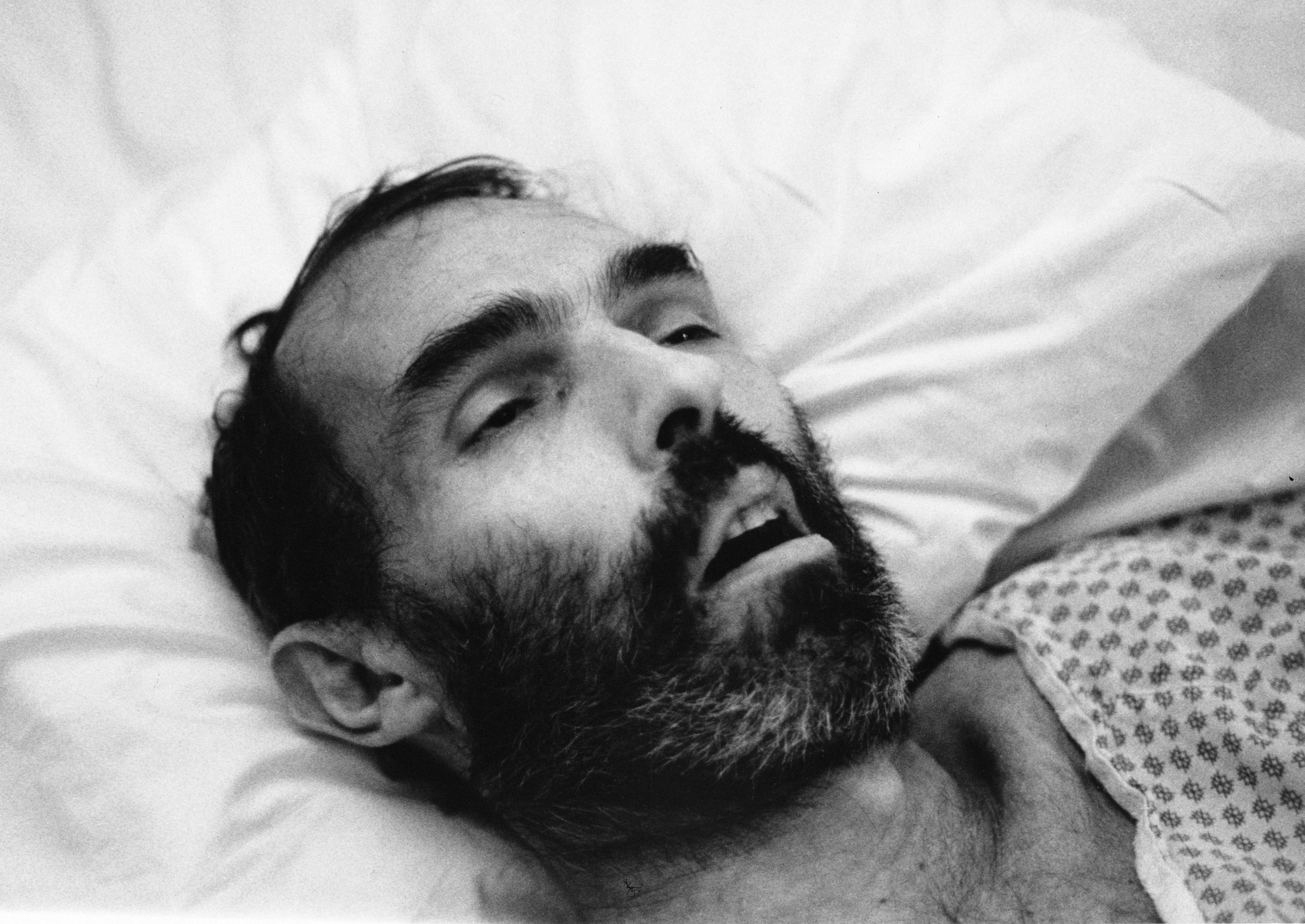
David Wojnarowicz, Untitled (Peter Hujar), 1989. Courtesy the Estate of David Wojnarowicz and P·P·O·W, New York. Image sourced via Elephant.art.
What David's passion and anger created was a space that captured the essence of moments, places, and people the world would have otherwise allowed to disappear. His passion is almost unfathomable, giving rise to a profound commitment to preserving personal memory and sharing it publicly—to scream, above all else, "we are here."
SECTION III
AIDS, Death, and the Politics of Remembering
When forgetting becomes an active decision made by society, as it did during the 1980s, memory shifts from a personal experience into an outward act of resistance. Because gay and bisexual men were already subject to deep societal neglect before the epidemic, AIDS only gave many people another excuse to look away from an already marginalized community. Only now, those same people were dying at disproportionate rates. Queer lives disappeared, and people died without a face.
Despite growing pressure from researchers and the affected community, President Ronald Reagan did not publicly acknowledge AIDS until September 1985—four years after the epidemic had officially begun—calling it a "top priority" only in response to a reporter's question. He did not deliver a formal public address on AIDS until 1987. By then, more than 21,000 Americans had already died from the disease.
With widespread stigmatization surrounding the gay community and many conservatives within the Reagan administration viewing AIDS as a religious punishment for homosexuality, federal funding for AIDS research remained so limited that Congress was forced to appropriate additional funding independently.
In a world that seemed willing to let this community quietly disappear, Wojnarowicz refused to allow that to happen. Everything he expressed through his art became an act of protest because it left evidence of these lives, forcing the world to confront a community it had tried to render invisible. I find this akin to poltergeists: figures believed to be unseen, yet still capable of interacting with the physical world and leaving undeniable traces of their presence, shifting the world around them despite every attempt to erase them.
SECTION IV
The Archive After Wojnarowicz
Wojnarowicz and his work serve as reminders of the significance not only of queer visibility and political activism, but also of preserving memory and sustaining shared values. Many communities in the United States, including African American and Asian American communities, continue this work today. Through collections, photographs, storytelling, and art, they grant their cultures a kind of immortality by building archives and uncovering narratives that might otherwise remain unseen or unknown to future generations.
David is truly one of the most inspiring artists I have discovered. He has shown me that memory is always worth externalizing and sharing. His work has left an enduring impact on the queer community and humanity by encouraging us to keep experience and memory alive while we are here. It reminds us that our stories live on even after we’re gone, and that before they allow the world to remember us, they allow us to remember us.
BIBLIOGRAPHY
Asian American Art & Culture Initiative. “Welcome to Asian American Art & Culture Initiative.” Asian American Art & Culture Initiative, aaartculture.org/about-us-1. Accessed 2 Aug. 2026.
Bennington-Castro, Joseph. “How AIDS Remained an Unspoken-but Deadly-Epidemic for Years.” History.Com, A&E Television Networks, 28 May 2025, www.history.com/articles/aids-epidemic-ronald-reagan.
Burrington, Ingrid. “Conflating Art and Journalism Is Bad For Both.” Life Winning, 7 Sept. 2016, lifewinning.com/2016/09/07/doing-a-journalisms.html.
Cross, LaToya. “Preserving Black Culture in a Time of Erasure.” Outlier Media, 28 July 2026, outliermedia.org/black-bottom-archives-artists-cultural-preservation/.
The David Wojnarowicz Foundation, The David Wojnarowicz Foundation, wojfound.org/scholarship/intro-scholarship/fales-library-special-collections-nyu/. Accessed 26 July 2026.
“The HIV/AIDS Epidemic and Public Broadcasting.” American Archive of Public Broadcasting, americanarchive.org/exhibits/hiv-aids-and-public-broadcasting.
Accessed 31 July 2026.
Jerome, Melissa. “Unlocking the Power of Newspapers: A Valuable Resource for Research, Teaching, and More " Communications " Uf Libraries " University of Florida.” UF Libraries, 27 May 2025, communications.uflib.ufl.edu/2025/05/27/unlocking-the-power-of-newspapers-a-valuable-resource-for-research-teaching-and-more/.
Mintcheva, Svetlana. “David Wojnarowicz - Censored Once Again.” National Coalition Against Censorship, 15 Jan. 2016, ncac.org/news/blog/david-wojnarowicz-censored-once-again.
Myers, Lillian Joy. "Changing the channel: How queer representation in mainstream media influences social perceptions in young adult viewers." (2025).
Ortiz, Jacqueline A. "Silence from the great communicator: the early years of the AIDS epidemic under the Reagan administration." Swarthmore Undergraduate History Journal 4.2 (2023): 76-99.
“Reagan’s Legacy.” San Francisco AIDS Foundation, 10 Feb. 2011, www.sfaf.org/news/reagans-legacy/.
Santos, Ana Cristina. "‘In the old days, there were no gays’–democracy, social change and media representation of sexual diversity." International Journal of Iberian Studies 29.2 (2016): 157-172.
Winslow, Margaret. “Silence = Death.” Delaware Art Museum, 13 Apr. 2021, delart.org/silence-death/.
Zwickler, Phil. Interview with David Wojnarowicz on the Exhibition "Witnesses Against Our Vanishing." 1989. Courtesy of the Phil Zwickler Charitable and Memorial Foundation Trust. Sourced via https://wojfound.org/exhibition/witnesses-against-our-vanishing/.
