
Sonia Boyce and the Construction of Identity
Avery Thomas
22 August 2026
WHAT IS IDENTITY?
In a general sense, I think of identity as simply who you are. However, it can be broken down into so many different pieces that render it actually complex. Is identity who we think of ourselves as, or how others see us? We’re made up of so many different parts, some that exist inside of us and others outside. How we interact with the world and people is an identity that exists solely through the eyes of others. Our experiences mold us everlastingly into who we are. That mold is explicitly inside of us—an inner identity that stays with us when we’re alone. How we project that inner identity to the world is what creates the other part of our identity: how we’re known.
Through the lens of art, I find that it works in a rather similar manner. It’s compelling how what exists inside an artist emerges from their work. Often, an artist’s work is an outward manifestation of self and a way of explaining their experiences through depiction.
Sonia Boyce is one of those artists whose work possesses these qualities. Every piece feels like it’s part of a map of her mind. Something is fascinating about how she searches for answers to the questions she asks of her life through herself, even when those thoughts consist of people like her parents and family, their lives, and the choices and desires that led them to the UK, as well as their experience of that world and the racism and lack of representation within it.
The way in which I’ve described identity gives me the idea of bringing into this writing what I see from my perspective, what Boyce sees, and what this suggests about identity.
Through her self-portraits, Boyce shows viewers that identity isn’t something that exists solely within us, but it is also something that is continuously built upon through our personal experiences, history, and the manners in which others see us. By looking at her work, I would like to understand how Boyce uses her own image to question the identities placed upon her, and what she constructs herself.
THE SELF IN THE IMAGE
Sonia Boyce’s early work approaches identity not as something fixed and private, but as a fluid and ever-changing performance shaped by the world around her. In a conversation with Manthia Diawara, she explained, “First and foremost I speak to myself. Which isn’t as solipsistic as it sounds: I speak to myself because of what’s going on around me.” This speaking to herself as a result of all that happens around her is especially important when understanding her portraits. These ideas, coupled with the evident values of personal subjectivity found in her work and its connection to social experiences, create something that, to me, feels foreign yet somehow quite familiar. I can’t explain why it makes me feel so.
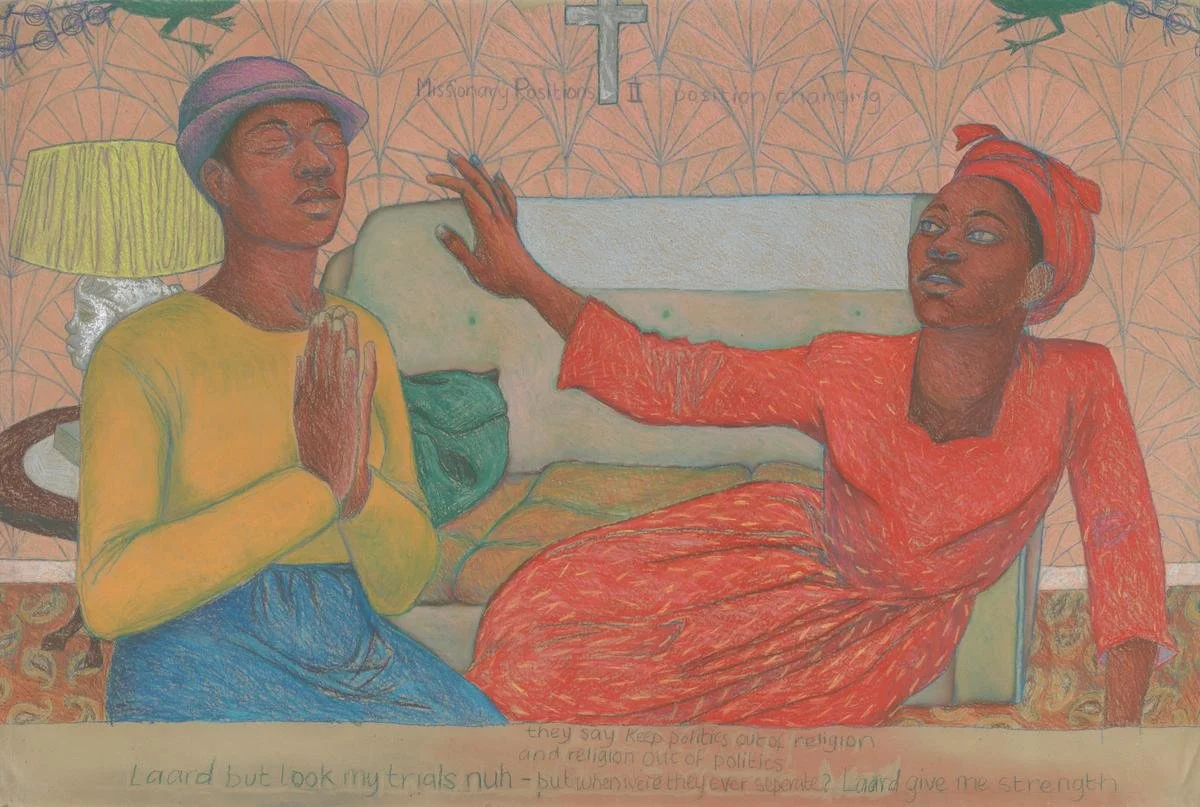
Boyce, Sonia. Missionary Position II. 1985, Tate, www.tate.org.uk/art/artworks/boyce-missionary-position-ii-t05020.
In Missionary Position II, Boyce depicts herself in two positions. On the left, she has herself kneeling in prayer. She wears solid, muted colors and a hat that almost bleeds into the world around her. With her eyes closed and hands clasped together, she’s in a state of undeniable praise, unable and perhaps unwilling to move or be disrupted.
On the right, with open eyes and an outstretched hand, she extends herself towards the figure in prayer, seemingly for confrontation. She wears a red dress with a print and a headwrap whose colors stand out from the space. There’s something about her body language—the way she reaches out to herself isn’t in a harsh manner at all, but in a way that calls for discovery of self.
Using just the work’s title and the words alone that are included in the piece, it exhibits this display of the interconnected world in which race, religion, and politics abide. When I consider her thoughts of her parents and their generation, and those who came to the UK and their reasons for doing so, this also feels like a direct call to the colonization of Africa and the role that Christian missionaries played in this world and identity, which could be described as “false” in the sense that these beliefs were forced and bestowed in oppressive manners by those missionaries. This connection is also supported by the historical context of the work itself: Tate describes Missionary Position II as a reflection of Boyce’s growing antipathy toward her Christian upbringing, while the title functions as this metaphor for the part that Christian missionaries played in imposing colonial rule and oppression. Tate further describes her Christian upbringing as having been used “as a tool of Imperial control,” which makes the relationship between religion, colonialism, and identity within the work much more explicit.
The phrase at the bottom of this work is Jamaican Patois dialect represented in written words, a visual connection to her Caribbean heritage. The words support these ideas that Boyce is sharing visually: “they say keep politics out of religion / and religion out of politics / but when were they ever separate?” Surrounding the recently mentioned phrase are the words, “Laard but look at my trials nuh / Laard give me strength.” She simply longs for understanding as she prays for strength. The battle one fights within oneself over what is true has occurred in every one of us. When you spend your whole life believing something, the simple act of questioning opens something within yourself—something that makes you ask questions about your experiences that inevitably bring you closer to clarity. This separation of the two forms returns me to one of the larger questions of identity.
So, if two things are truly one, why did we ever think they were two? Perhaps it makes things simpler to believe they are. To believe they are two closes the door to even a question that you never thought of asking, to which its answer you’d likely never be prepared for. That’s the hard part—confronting the unknown. Yet Sonia takes on the challenge with Missionary Position II, which raises an interesting question about human craft: through the practices and means of understanding that we use to explain ourselves and the world, did we discover a hidden truth through them, or were we already aware of what we deemed our reality and identity to be?
WHO IS LOOKING?
The identity that is held within a self-portrait seems to undoubtedly belong to the artist, but in the same instance, the work exists for a spectator as well. So, can the self ever be self-defined? Even with what I myself am doing now, analyzing self-portraits of Sonia Boyce, I am defining who she is through how I see her work. While the artist controls the sheer creation of the image, she cannot completely control what happens to the image once in the hands of another. The identity she constructed then becomes subject to external interpretations and perceptions, which technically holds the viewer as a part of the process regarding the construction of meaning.
In a Frieze article from Issue 226, Sonia talks about surpassing “the deconstructive stage of this equals that,” which I find quite apparent in her work. To me, this idea of moving beyond “this equals that” is significant because identity cannot simply be reduced to one thing representing another. Boyce’s work constantly complicates these relationships between what is seen and what something is supposed to mean. Her self-portraits do not simply say this is who I am; instead, they question how an identity becomes attached to an image in the first place.
This becomes particularly significant when considering Boyce’s own family history and the larger history of Black British identity.
The entire occurrence of the British Empire seems very significant when it regards the themes discovered in her pieces and maybe even further, a reason for why she creates to begin with. The British Nationality Act of 1948 granted British citizenship to citizens of colonies and dominions under British rule. The National Archives explains that this contributed to over two decades of migration to Great Britain from the Caribbean during the post-war era, while also creating a complicated relationship between British citizenship and who was actually considered British. This caused a lot of discourse among the British government about what it meant to be British and how it did not coincide with being non-white.
The politics of a situation like this instilled questions of “Who am I?” in people like Sonia’s parents, who moved to Great Britain as British citizens but were not considered British and were treated as less-than, unwanted foreigners. It intrigues me greatly to hear how Boyce questioned their decision to immigrate to Britain. I can only imagine the types of questions she might have asked, like, If we’re citizens, why aren’t we treated as such? which raises the other question of Why did they move here? Were they moving away from or towards something?
To leave your home country and immigrate to another without your culture, and then to be treated as someone to be extinguished, might raise questions such as: What was wrong with how we lived? What’s wrong with our culture? Sonia’s depiction alone of experiences and thoughts like this is precisely what makes her work so striking. She breaks down identity in a way that can’t be explained perfectly, in a way that you can’t just describe yourself with one word.
CONSTRUCTING IDENTITY
With Sonia’s consideration of identity as a performance, her work asks who we are based on our surrounding influences, like daily encounters with society and history. One idea that I find particularly powerful is the deconstruction of stereotypes and reclaiming that control over your performance, because it is truly no one else’s but yours—not the media’s, not history’s, but yours.
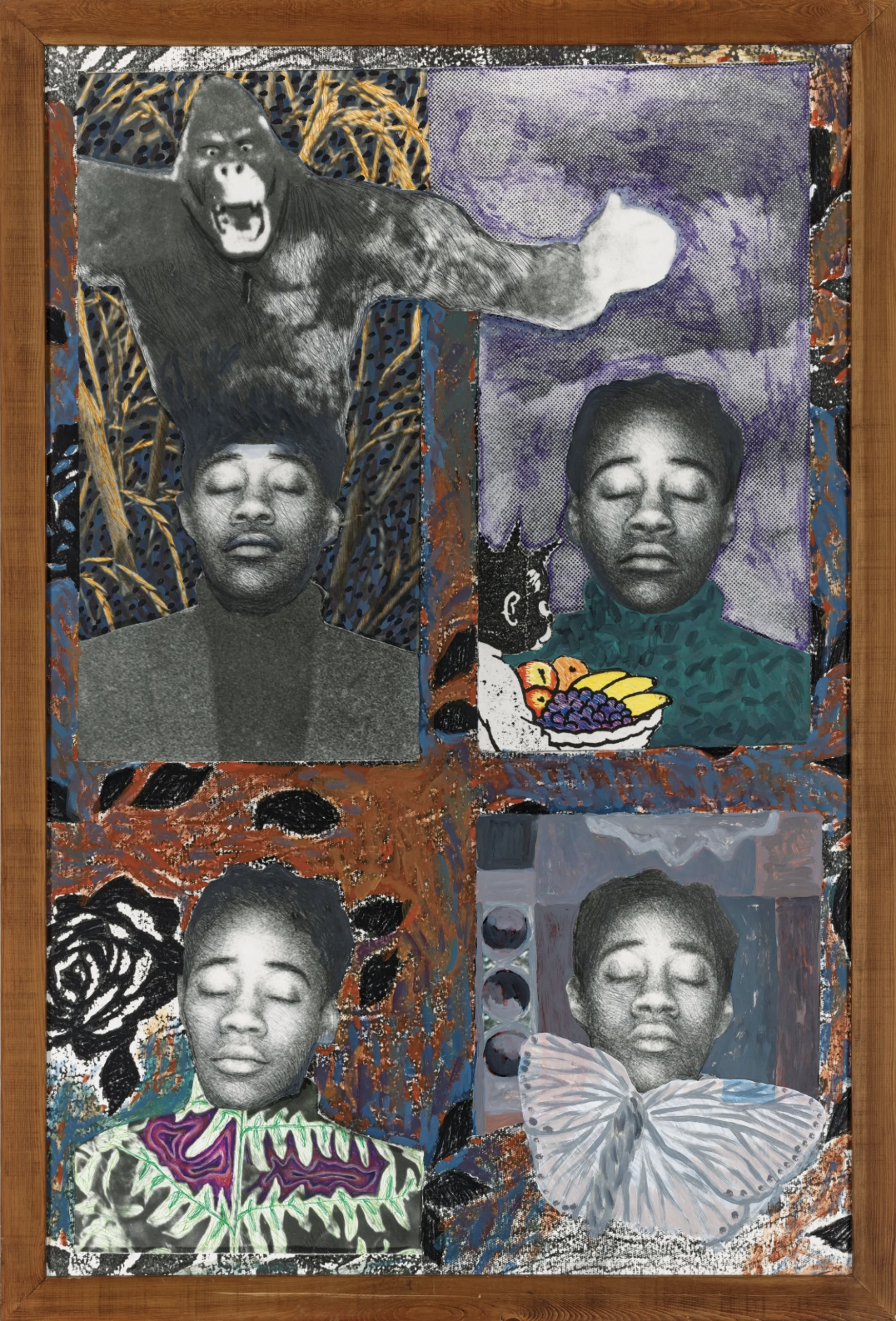
Sonia Boyce, From Someone Else’s Fear Fantasy (A Case of Mistaken Identity? Well This Is No Bed Of Roses) To Metamorphosis, 1987. Unsold at Christie’s, acquired by National Portrait Gallery. © Sonia Boyce. All Rights Reserved, DACS 2025. Photograph by Tim Bowditch. Purchased with kind support from the Bukhman Foundation as part of Collecting the Now, formerly in the collection of British artist Sutapa Biswas. Courtesy National Portrait Gallery. Image sourced via britishartfair.co.uk
Her piece, From Someone Else’s Fear Fantasy (A Case of Mistaken Identity? Well This Is No Bed Of Roses) To Metamorphosis, brings quite a special idea to this concept of performance. Her facial expressions are what caught my eye first; they seem content, self-assured, peaceful. They all have this feeling that conveys an internal existence and self-sufficiency, like everything she needs is within her.
With a raging gorilla and racist depictions of Black people in cartoons, she shuns these societal portrayals of her as a Black woman and takes the narrative into her own hands, not allowing anyone or anything to overshadow her performance of who she is. After all, she’s an artist whose work quite literally revolves around reconstructing the identity that society tried to destroy.
There’s a lot to be learned and cherished through Boyce’s practice. Her outlook extends across every aspect of life and expression of self. Her work is a reminder that identity shifts constantly, and her approach demonstrates that we have multiple identities based on both internal and external influences. As much as it’s true that one may have identities forced and projected upon them, it’s equally true that only the individual can perform and control, within their being, what they want others to see.
So, if identity can be constructed through representation, then the self-portrait isn’t just a simple and clear reflection of who we are, but this sort of hub where identity from the source is made visible, questioned, and remade.
BIBLIOGRAPHY
Boyce, Sonia. “Sonia Boyce: ‘Gathering a History of Black Women.’” Tate, 27 July 2018.
ch807. “Reaia Parkes: Sonia Boyce’s Missionary Position II.” Art History News, 14 June 2022, blogs.kent.ac.uk/artistry/2022/06/14/reaia-parkes-sonia-boyce-missionary-position-ii/.
“Crisis of Britishness? Immigration, Race and Nation in Modern Britain - the Wiener Holocaust Library.” The Wiener Holocaust Library, wienerholocaustlibrary.org/exhibition/crisis-of-britishness-immigration-race-and-nation-in-modern-britain/.
Dalal-Clayton, Anjalie. "Sonia Boyce: Beyond Blackness." Nka: Journal of Contemporary African Art 2019.45 (2019): 62-73.
Dexter, Emma, and Sonia Boyce. “Explore From Tarzan to Rambo.” Tate.
Diawara, Manthia, and Sonia Boyce. “The Art of Identity.” Transition, no. 55, 1992, pp. 192–201. JSTOR, https://doi.org/10.2307/2934865.
“Empire Windrush: Early Black Presence.” The National Archives, The National Archives, www.nationalarchives.gov.uk/education/resources/the-empire-windrush/early-black-presence/.
Harbison, Isobel, and Sonia Boyce. “Me, Myself and Others.” Art Monthly, Apr. 2018.
Owusu, Julian, and Sonia Boyce. “Dreaming Utopias Into Existence: A Conversation With Sonia Boyce.” NO NIIN, Oct. 2022.
“‘Missionary Position II.’” Tate, www.tate.org.uk/art/artworks/boyce-missionary-position-ii-t05020.
